






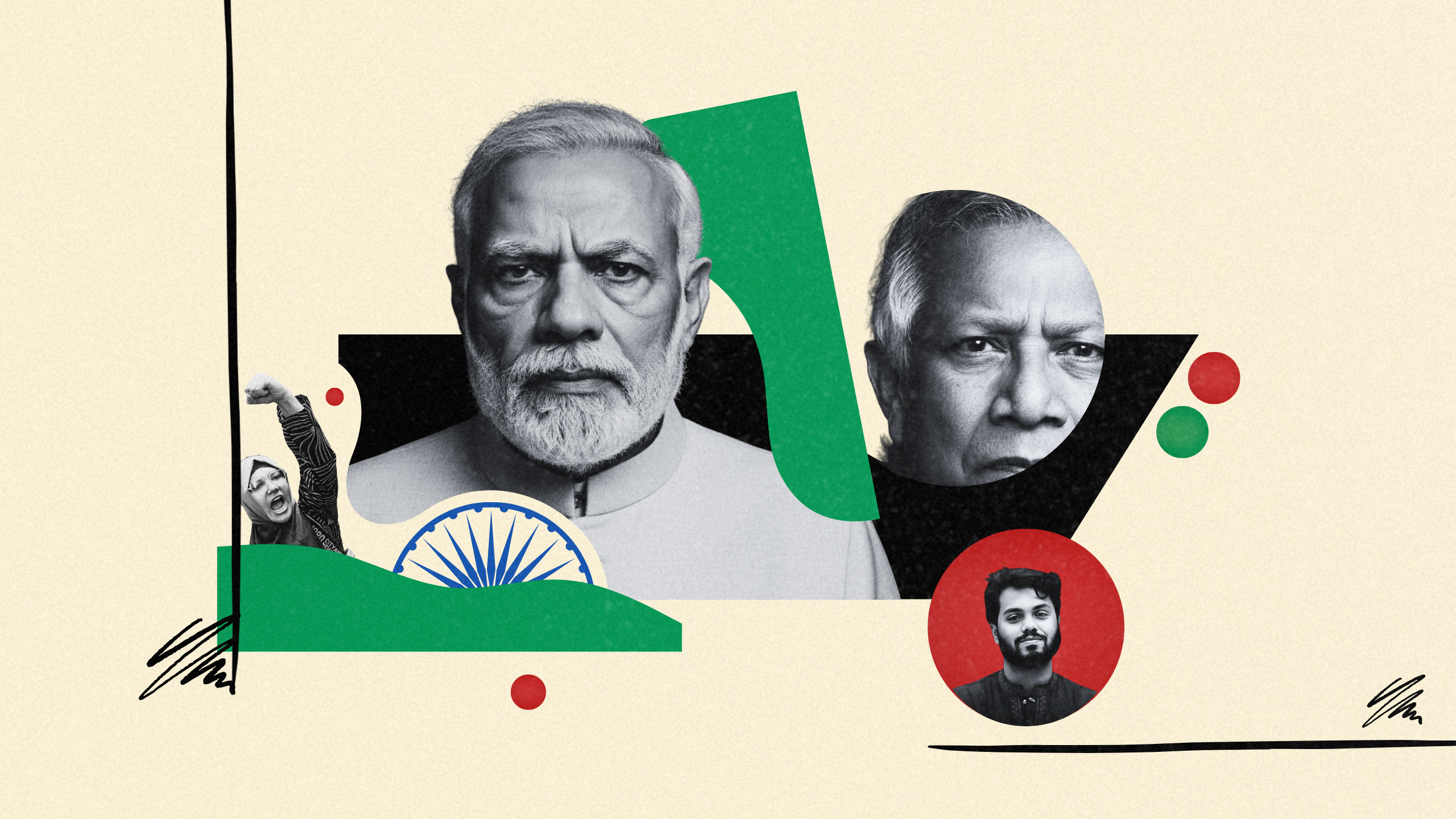
On the night of 18th December 2025, minutes after news broke about the death of the key July uprising figure, Sharif Osman Hadi, scenes of violence, vandalization and anti-India protests emerged at various locations of Bangladesh.
Hadi, a youth activist and leader from Inquilab Manchus, was shot while leaving a mosque in Dhaka on 12th December & was undergoing treatment in Singapore. The shooting came a day after dates for the first elections after the 2024 ‘July Uprising’ were announced, in which Hadi was planning to contest.
Hadi a key figure in ousting Sheikh Hasina during the ‘July Uprising’ was also known for his anti-India stance for giving safe haven to former PM Sheikh Hasina as well as envisioning the concept of ‘Greater Bangladesh’ by claiming area of the Northeastern states of India. 
After his death, while the Bangladeshi government declared a national mourning on 20th December, surprisingly, the US embassy in Bangladesh also paid homage to the deceased, despite Hadi’s anti-India activities, cementing hints about the US involvement in the Hasina government fallout in Bangladesh.
VIOLENCE, VANDALISM, PROTEST
The protests in Bangladesh began on late hours of 18th December with Hadi’s supporters gathering in a square in Dhaka, which later turned violent with vandalisation of the offices of Bangladeshi newspapers The Daily Star and Prothom Alo.
On 19th December, the demonstrators carried vandalisation at Bengali cultural centre, Chhayanaut, torched the home of Sheikh Mujibur Rahman in Dhanmondi and even bulldozed the office of the Awami League in Rajshahi. On 20th December, the crowd funeral procession of Hadi stormed the National Assembly of Bangladesh, looting and vandalising the structure of democracy.
ANTI INDIA SENTIMENTS ON RISE
On 17th December, protestors under banner of ‘July Oikya’ protested near the Indian Embassy in Dhaka, raising anti-India slogans and demanding repatriation of former PM Sheikh Hasina. On 18th December, anti-India protests emerged in Khulna and Rajshahi near Indian visa application centre/Assistant High Commission, leading to suspension of services.
Further, on 19th December, Indian Assistant High Commission in Chattogram’s Khulshi area was attacked by protestors leading to suspension of visa operations from 21st December.
Prior to these incidents on 17th December, India summoned Bangladesh’s High Commissioner and expressed rising security concerns, after Bangladeshi youth extremist groups announced to create chaos near India’s diplomatic mission area.
India has been blatantly blamed by many extremist groups in Bangladesh for causing unrest in the nation, eliminating youth leaders, as well as for safeguarding former PM Sheikh Hasina. The accusations of Hadi’s death on India are placed by anti-India forces to destabilise India-Bangladesh relations, despite the brother of Sharif Osman Hadi, Omar Hadi, accusing the Yunus govt. for murder for delaying elections.
Further, the anti-India propaganda of separating the Northeast Indian states has constantly been pushed by newly formed organisations like Hadi’s Inquilab Manchus and Hasnat Abdullah’s National Citizen Party, along with disinformation campaigns against India by Jamaat-e-Islami, as well as allegedly by Pakistan and Türkiye.
Earlier in March 2025, during his China visit, Mohd. Yunus, the chief advisor of the interim government of Bangladesh, sparked a row by presenting the northeast Indian states as landlocked and Bangladesh to be the only guardian of the Indian Ocean in the region, further inviting China to utilise Bangladesh as a gateway to the Indian Ocean.
RADICALISATION IN BANGLADESH
Since the ‘July Uprising’, a constant push to Islamic radicalisation in Bangladesh has been observed by conservative Islamist parties like the Jammat-e-Islami, visible through ongoing violence against minorities and their culture in the South Asian country.
The recent case of the tragic killing of a Hindu man named Dipu Chandra Das in Mymensingh over blasphemy has sparked nationwide protests in India on 23rd December with demonstrations in front of Bangladeshi High Commissions in New Delhi and Kolkata, for ensuring the safety of minorities in Bangladesh.
India also summoned the Bangladeshi High Commissioner and raised objections about the situation of minorities in the nation.
DEVELOPMENTS AND CONCLUSION
Days after Hadi’s death, which triggered unrest in Bangladesh, one more youth leader named Mohammad Motaleb Sikdar, the Khulna divisional chief of the National Citizen Party, has been shot in Khulna by unknown shooters, further enhancing ongoing unrest and anti-India sentiments in Bangladesh.
The unrest, which accompanied violence and protests against India, its diplomatic mission and minorities in Bangladesh, has now turned into a diplomatic row between the two nations, with Bangladesh also halting visa operations in New Delhi and Agartala, as well as its interim government’s foreign affairs advisor, M. Touhid Hossain, commenting to scale back its diplomatic presence in India.With this, the two neighbouring nations inch closer to a ‘diplomatic fallout’, leaving the South Asian region in ashes with prevailing instability in countries like Nepal, Bangladesh, Sri Lanka, Pakistan and Myanmar, thus affecting regional well-being, peace and cooperation and raising new challenges for biggest nation India.


Really insightful content
Great Article
Go Team Ties!
Informative and well-researched
Love the analysis!
Very well articulated