





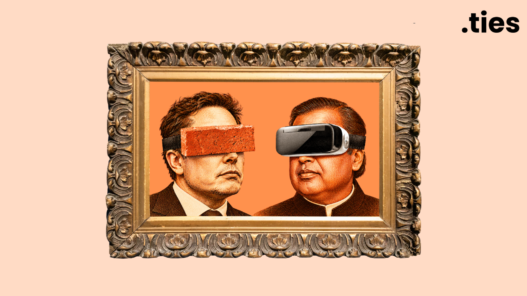

In the second week of October 2026, Elon Musk did two things at the same time. In America, fresh campaign finance filings confirmed that he had become the single biggest known donor of the midterm election, with at least $366 million given so far to help Republicans keep control of Congress. In India, he took to X and asked whether Mukesh Ambani is “the real boss of India,” accusing unnamed “oligarchs” of holding a “monopolistic chokehold on the Indian people” by keeping his satellite internet company, Starlink, out of the country.
One man, two countries and two completely opposite postures on money and power. In one country, he is the money. In the other, he is the accuser. That contradiction is the story.
What Musk is doing in America
Start with the numbers, because they are staggering. Federal Election Commission filings made public this week show that Musk poured more than $276 million into federal political groups in just three months, July to September 2026. The breakdown:
- $158 million to the Senate Leadership Fund, the main Republican Senate super PAC
- $20 million to the Congressional Leadership Fund, its House counterpart
- More than $76 million to America PAC, his own political action committee
- $10 million to Lone Star Liberty PAC, backing Ken Paxton’s Senate run in Texas
- $10 million to the Republican Governors Association
- $2 million to the Republican Attorneys General Association
Added to what he gave earlier in the cycle, his total contributions this midterm season stand at $366 million, a figure his own America PAC confirmed. That is more than he spent across the entire 2024 election, when his roughly $288 million made him the biggest donor of the Trump cycle. Election Day 2026 is still weeks away.
The Texas operation shows how this money works at full strength. On September 9, Musk gave the Senate Leadership Fund $75 million. The next day, the fund moved exactly $75 million to Texas PAC, the super PAC backing Paxton. On September 23, he gave $83 million. The next day, exactly $83 million moved to Texas PAC again. Through the end of September, Texas PAC reported no other donors. One man is single-handedly financing a Senate campaign in America’s second-largest state, a race national Republicans had been reluctant to spend on. His money erased that calculation.
Then there is the advertising. America PAC and the groups he funds are running culture-war spots: attacking Alaska Democrat Mary Peltola as “too radical for Alaska,” warning that the “socialists” who “took New York City” are now “coming for all of America.” These are emotional appeals aimed at conservative voters who do not always turn out, spread across roughly three dozen tight House races in 16 states and seven Senate battlegrounds.
The reversal is as striking as the scale. In May 2025, Musk said he would spend “a lot less” on politics. In a July interview he admitted he had “got carried away” and become “a little too involved.” He had left the Trump White House in late May 2025 after a public falling-out, and even threatened to form his own political party. All of that is over. He has been at Trump’s side repeatedly in recent weeks, joined the president’s state visit to China, and on October 8 – the very week his India offensive began – Trump presented him with the National Medal of Science.
Why is he doing it? His spokesman’s stated reason: if Democrats take Congress and key state offices, “America risks becoming a socialist, woke and borderless country.” Reporting on his thinking adds a harder edge: a Democratic-controlled Congress could investigate his businesses, his AI interests, his foreign entanglements, and the Department of Government Efficiency he once ran. Probably both are true. Either way, no individual in American history has spent like this in a midterm.
And here is the part that matters for the comparison: none of it is illegal. Since the US Supreme Court’s 2010 Citizens United decision, super PACs can raise and spend unlimited money from individuals as long as they do not formally coordinate with campaigns. The 2026 cycle is projected to shatter all records with $11.6 billion in political advertising. Musk is not breaking America’s system. He is its most extreme product.
What Musk is saying about India
In the very same days, between October 7 and 16, Musk ran a parallel campaign on X aimed at India. The timeline:
- October 7: He declared that Starlink was “being blocked by certain oligarchs in order to maintain their monopolistic chokehold on the Indian people,” adding “You can guess who they are” and calling it “a crime against the people of India.”
- October 8: India’s Ministry of Communications rejected the charge as “baseless and misconceived,” stating that all three licensed satellite operators – Starlink, Jio Satellite Communications and Eutelsat OneWeb – are at broadly the same stage of security review. Hours later, Musk escalated: “Starlink is licensed in over 165 countries and has spent five years complying with every single law and requirement of the government of India, so why still no license? Is Ambani the real boss of India?”
- October 9: He addressed Mukesh Ambani directly with open sarcasm: “Dear Prime Minister Ambani, Please accept my humble apologies for not realising that you are the real boss of India… would you nonetheless consider allowing Starlink to compete?” Opposition leader Rahul Gandhi replied: “Welcome to India, Elon. Wait till you discover the other guy,” a reference to Gautam Adani. Musk answered: “Thank you, Rahul. This is indeed troubling.”
- October 10: Musk shared two news reports linking Ambani’s Reliance conglomerate to donations received by the BJP: a 2022 investigation into a Reliance-funded firm boosting the BJP’s campaigns on Facebook, and a 2024 report that Qwik Supply, a company linked to Reliance, had donated about 30 million pounds to the BJP and 2 million pounds to the Shiv Sena through electoral bonds, the anonymous funding route India’s Supreme Court struck down as unconstitutional in 2024. Reliance has said Qwik Supply was not a subsidiary of any Reliance entity; company filings cited by Reuters showed three Reliance firms together held a 50.04 percent stake in it.
- October 16: Reliance broke its silence, saying it had “never feared competition,” that it welcomes competition including Starlink, that the same approval process applies to Indian and foreign companies, and that its own satellite services await the same clearances. Bharti’s Sunil Mittal noted that OneWeb applied five years ago and is still waiting. Within hours, Musk replied to Reliance’s statement: “Much appreciated.” Starlink added that it has spent five-plus years working with Indian regulators, built in-country infrastructure “with the requisite government approvals,” and is “ready to connect India with high-speed internet.”
The reactions inside India cut across party lines. Communications Minister Jyotiraditya Scindia said India does not permit monopolies in any sector and is “technology agnostic.” AIMIM chief Asaduddin Owaisi, a fierce critic of Prime Minister Modi, still drew a line: “We were always against Narendra Modi and will remain so. But how can Elon Musk say this kind of thing about our India’s Prime Minister?” Akash Ambani declined to engage: “We want to be heads down and deliver value to our Indian consumers.”
Two things deserve to be said plainly. First, Musk’s core claim – that Ambani is personally blocking Starlink – remains an allegation. He has offered no direct evidence for it, and the government’s account, that all three operators are queued at the same security checkpoint, is supported by the fact that Jio and OneWeb have not launched either. Second, the delays are real, and so are the stakes: Starlink received its preliminary Indian licence in mid-2025, regulators have cited security concerns about its terminals, and millions of Indians in poorly connected districts are waiting while three billionaires’ companies sit in the same queue.
The mirror – connecting the dots
Lay the two weeks side by side and five points emerge.
1. Money is speech when it is his, corruption when it is theirs. In America, Musk’s $366 million is reported as campaign finance news – aggressive, unprecedented, but legal. In India, corporate donations linked to Ambani are presented by Musk as proof that the system is bought. It is the same phenomenon – very rich men converting wealth into political leverage – framed in opposite ways depending on whose money it is and whose market is at stake.
2. The real divide is not India versus America. It is disclosed versus undisclosed influence. America’s system, post-Citizens United, made billionaire spending legal and mostly disclosed: we know about Musk’s $366 million because the law requires it to be reported. India’s electoral bonds made corporate funding anonymous until the Supreme Court abolished them in 2024 and forced the data into the open. Neither system has removed money from politics. They differ mainly in whether voters get to see it.
3. Billionaire-versus-billionaire fights are fought in the language of the common man. Musk says Starlink is for India’s unserved villages, and he is right that those villages need connectivity. Reliance says India’s rules are the same for everyone, and it is true that Jio and OneWeb are waiting too. Notice who is not in the room: the villagers. As one space-industry report put it this week, Musk blames India’s oligarchs, New Delhi cites security, and the villages keep waiting.
4. Watch the framing, not the flag. When the world’s richest man calls another country’s richest man its “real boss,” the first question to ask is what the accuser is doing at home. Rahul Gandhi welcomed Musk’s attack as confirmation of his own long-running argument about cronyism. Owaisi rejected a foreign businessman lecturing India about its Prime Minister. Both men oppose the government; they still read the moment differently, because the question underneath – who gets to influence India, and from where – has no party line.
5. The irony writes itself. The man asking “Is Ambani the real boss of India?” is, by the public record, the largest known individual funder of the current American election. If money buys influence in New Delhi, it does not stop buying in Washington. The difference is that in Washington, the buying is itemised in federal filings.
What to watch next
- The final pre-election FEC filings, due before the November 3 vote, which will show whether Musk’s total climbs further.
- Whether India grants Starlink its final security clearance – and whether Jio and OneWeb receive theirs at the same time, which is the real test of the “level playing field” claim on both sides.
- Whether the “Much appreciated” thaw between Musk and Reliance holds, or the fight resumes.
The lesson for Indian readers is not that one billionaire is the villain and the other the victim. It is that in 2026, in the world’s two largest democracies, the ultra-rich no longer merely fund politics. In Washington, one of them is the largest political spender on record. In New Delhi, another stands accused – without proven evidence – of deciding who competes. Both claims deserve scrutiny, both systems deserve reform, and voters in both countries deserve to see the money clearly. Right now, only one of the two systems even shows them the receipts.