








Authored by Soniya & Shreya Vij.
Edited by Damini Agrawal
Oligarchy and the Question of Control
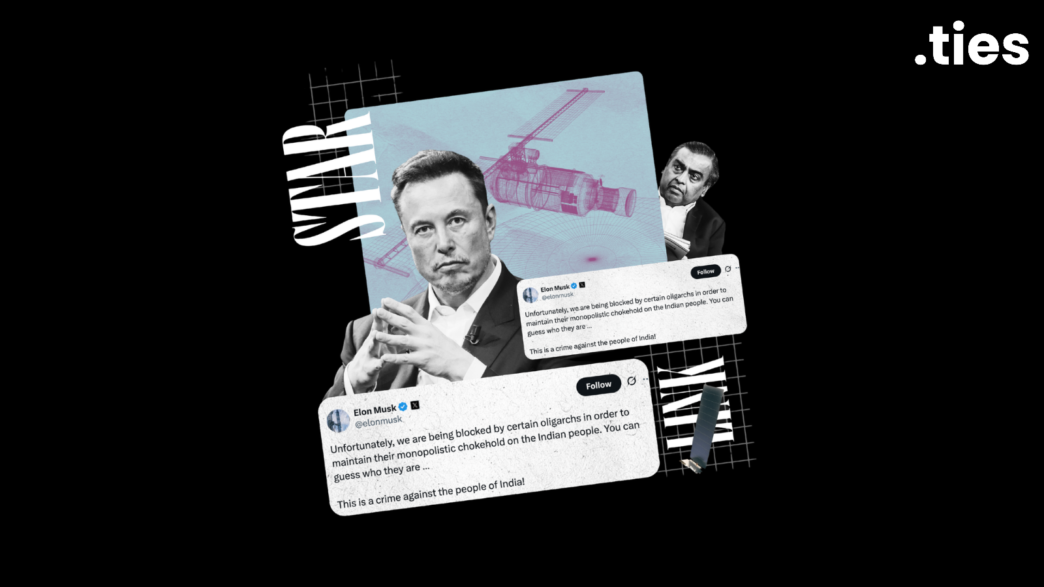
There is something almost hysterical about Elon Musk defaming Indian “oligarchs” of upholding a “monopolistic chokehold” over the internet market of India. The world’s most opulent man, whose organisations possess exceptional positions across automobiles, space, satellites and social media, is whining about oligarchy exactly when one of his companies wants access to one of world’s largest communications markets. However, beneath the cynicism lies a more serious question, what should India demand from a foreign-controlled communications network before permitting it to become strategically indispensable?
India’s Security Requirements
The allegations are that unnamed Indian magnates are deliberately averting Starlink from entering the Indian market in order to safeguard their dominance. So far, India’s hesitation is not merely limited to a telecom competition challenge. Security clearances remain unsettled, Indian authorities have augmented concerns about lawful interception, traffic routing, localisation of data and the capacity to regulate a constellation that operates across national boundaries. Therefore, India requires network control and lawful interception to remain within the country.
Oversight Beyond Today’s Network
The concern is not whether Starlink can technically conform with Indian rules today, but whether India can sustain substantial sovereign oversight as the technology develops.
The concerns intensify when Starlink’s framework is considered beyond its present form. The company has made its Indian gateway infrastructure and claims it has customized its security program according to Indian requirements. It has also sought approval for a much larger Gen-2 constellation incorporating direct-to-device connectivity. This technology could let phones communicate directly with satellites rather than depending upon the conventional terrestrial infrastructure. Reportedly, Indian authorities have examined Starlink’s inter-satellite laser links separately to examine whether this could allow traffic to cross jurisdictions apart from conventional national routing frameworks. The concern is not whether Starlink can technically conform with Indian rules today, but whether India can sustain substantial sovereign oversight as the technology develops.
Ukraine: The Risks of Private Control
Considering Ukraine as a serious precedent, Starlink eventually became critical to the Ukrainian military communication channels during the war. Reuters reported, however, that Musk particularly commanded a shutdown of Starlink services over certain areas in Ukraine during the Ukrainian counter-offensive operations in 2022. The interruption disrupted the whole military communications and operations. This incident illustrated a serious concern for governments; that a strategic infrastructure may have a private ownership, but its repercussions are sovereign in nature.
Iran: Connectivity Beyond State Restrictions
Iran turns out to be another curious case of caution. Starlink was operational when Tehran inflicted extensive internet restrictions, and thousands of terminals were operating subsequently inside Iran without authorisation. The International Telecommunication Union (ITU) has recorded that Iranian authorities struggled to identify and situate every unauthorised Startlink terminal. Ironically, the same framework is being marketed in India as “a solution to rural connectivity issues”, and under distinct circumstances became a connectivity lifeline during war, protest or state-imposed shutdowns.
The Dual-Use Challenge
A network that can function beyond existing conventional terrestrial chokepoints can equip citizens during blackouts and also potentially generate channels that a state finds challenging to scrutinize or disable.
India must confront such dual-use issues. Considering that internet connectivity is a civilian infrastructure with real time involvement. But connectivity is also a command infrastructure, intelligence infrastructure and crisis infrastructure. A network that can function beyond existing conventional terrestrial chokepoints can equip citizens during blackouts and also potentially generate channels that a state finds challenging to scrutinize or disable.
Manipur and the Smuggling Route
Manipur shows that the risk is not theoretical. In December 2024, the Army, Assam Rifles and Manipur Police recovered a Starlink dish and router in Imphal East, alongside a rifle, grenades and detonators; security sources said the equipment was marked “RPF/PLA”, linking it to a Meitei insurgent group. Weeks earlier, police in the Andaman and Nicobar Islands found a Starlink terminal on a boat carrying methamphetamine worth $4.2 billion from Myanmar. Hardware was already moving through a conflict zone and a smuggling route before the service was licensed. In January 2025, The Guardian reported that a PLA member said the group first used its terminal in Myanmar and then found it worked inside Manipur during government internet shutdowns; security sources also believed Starlink worked in some areas near the border.
Who Controls the Beams?
A beam does not respect a map line; “off” is a commercial geofence that Indian agencies cannot independently audit. And the claim concedes the larger point: if beams can be turned off, someone holds the switch.
Musk’s defence is that the beams are off. In December 2024 he said they were “never on in the first place”. On 7 October 2026, the same day he called the alleged blocking “a crime against the people of India”, he repeated that use “by anyone for any reason” was “absolutely false”. This claim warrants scrutiny. Experts reportedly found the seized unit did not work in Imphal, and security sources doubted it was used where it was found, yet the same sources insisted it was active along the Myanmar border. A beam does not respect a map line; “off” is a commercial geofence that Indian agencies cannot independently audit. And the claim concedes the larger point: if beams can be turned off, someone holds the switch. SpaceX said in October 2025 that it had “disabled over 2,500” kits near Myanmar’s scam centres, which shows that the network is live in India’s neighbourhood and that Starlink alone decides who stays connected.
New Delhi’s Response
New Delhi has responded. On 8 October 2026, the Ministry of Communications dismissed the discrimination claim as “baseless and misconceived”, noting that Starlink, Eutelsat OneWeb and Jio Satellite hold licences, are at broadly the same stage, and can seek spectrum only after their security assessment is complete. Starlink says it has built 20 gateway sites and will keep Indian user data in India, but Bloomberg reported in June that Home Ministry agencies had withheld its final clearance over the use of its terminals in Iran.
Engagement on India’s Terms
None of this is “anti-technology” or makes one luddite. India should neither reject Starlink, nor justify protectionistic intents disguised as national security. It should engage with Starlink, but on its own terms: security clearance completed before the first paying customer; auditable geofencing and terminal registration, so that “off” can be verified. Interception, traffic control and routing rules, including for laser links and direct-to-device service, enforced inside India, and serious investment in domestic satellite capability so that sovereignty is not outsourced. Spectrum pricing, set at 5% of adjusted gross revenue by the Digital Communications Commission is awaiting Cabinet approval, and the foreign investment approval Starlink still needs are India’s leverage, not formalities.
The Sovereignty Question
Policy should not be made under pressure from a social media campaign.
This is a lesson to take home, that we must not end the conversation on Musk’s “monopolistic chokehold”. It is not about deciding whether another broadband provider can market its subscriptions. Predominantly, about how much strategic communications capacity should be entrusted to a foreign private player whose entire operational control lies independent of the Indian state. Policy should not be made under pressure from a social media campaign. The question was never whether Indians deserve an affordable internet. It is rather who holds the switch.